
Moving hard-to-move materials — viably, affordably and accountably.
When distance, small volumes or empty return legs drive transport costs up, we help you bring the right carrier onto the route — one you already work with, or one we help you find — and coordinate the transport, custody and reporting that make it work. You keep the commercial relationship.
Who it's for
Whoever's holding materials that are hard to move — and the carriers who can move them.
Councils & regions
Move stranded materials to processors affordably, building the evidence to support funding and policy cases.
Scheme operators
Run verified, end-to-end collection for your materials, configured to each region.
Businesses
Turn awkward, sporadic material movements into coordinated, accountable loads.
Carriers & transport operators
Fill backhaul and spare capacity with loads that fit routes you already run.
Pickups that don't stack up alone, stacked together.
Loads from several councils along a corridor are pooled into one tracked run. A volume too small for one council to move on its own becomes viable shared across the corridor — the pickup that was never worth a truck suddenly is.
Each council keeps its own materials, records and reporting. Pooling only changes the economics of the run, never who owns what.
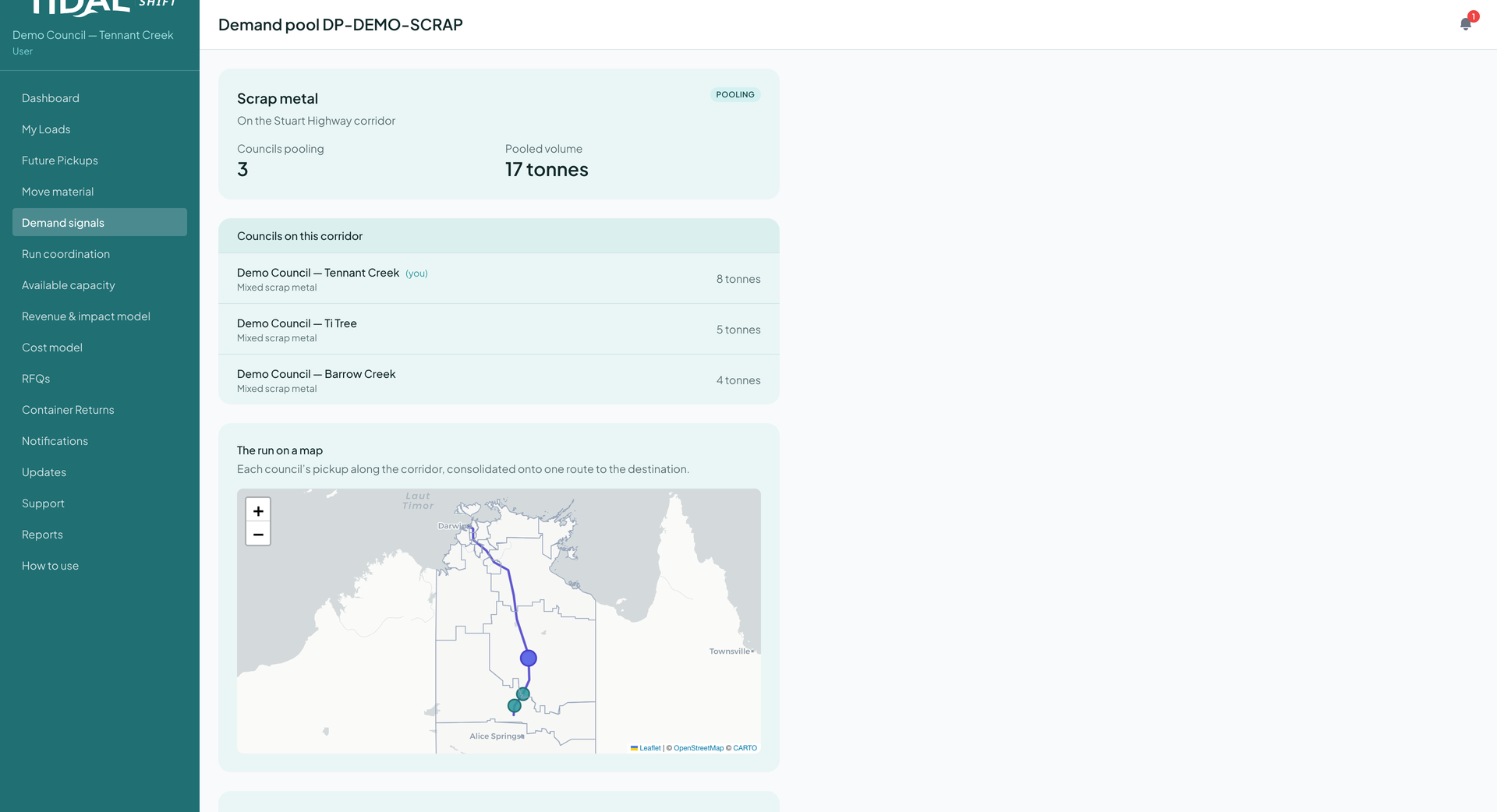
Illustrative demonstration data.
How it works
Whether the material can't move viably today, or already moves but could move more cheaply, cleanly and with better records, the process is the same — and it's built to flex to local conditions.
Consolidation or drop-off point added only where it helps.
You tell us what needs moving, and where to.
What it is, where it is, and where it needs to go.
More
A council, scheme or business identifies what needs to move out of their area — the material, where it is, how much, how often — and the destination or pathway it needs to reach. Where the end point isn't obvious, we work it out together.
Together, we bring the right carrier onto the route.
One you already use, or one we help you find.
More
With origin and destination known, we work with you to bring on the right carrier — often one you already use, sometimes one we help identify — with an offer that makes the run worthwhile: existing backhaul or spare capacity where it exists, a dedicated load with a confirmed destination where it doesn't. Always on your terms, and you keep the commercial relationship.
It's collected and moved.
One or several pickups, direct to destination.
More
Material is picked up — in one or several pickups, or from a drop-off point where it's been aggregated — and taken to its destination. Where it genuinely helps, loads can be brought together at a consolidation point first, but most often it moves direct.
Every movement is tracked.
Chain of custody and reporting, end to end.
More
From pickup to destination, the platform records chain of custody and operational and sustainability reporting — what moved, when, and where it went. In a pilot or scheme setting, that can extend to cost evidence for funding and policy cases.
Throughout, Tidal Shift coordinates and records — never a party to the contracts or the money flow. You keep your own commercial relationships; we make the movement work and give you the proof it did.
Why Tidal Shift
Neutral by design.
We coordinate and record — never a party to the contracts or the money flow. You keep your own carriers, rates and relationships; we don't compete with them or take a cut. That neutrality is also what brings carriers to the table: an operator who'd never hand loads to a freight broker will look at a backhaul that's coordinated, not brokered — which is often what unlocks a route a council couldn't move on its own.
Implement, not just investigate.
You're left with a working pathway and a tool you keep using — not a report that names the problem and stops. The movement actually happens, and the platform keeps coordinating it run after run.
Configured to local conditions.
Every region's routes, sites and volumes differ. The platform flexes to how your area already works — your existing carrier relationships, a drop-off point, a consolidation hub where one helps — rather than forcing a single model onto it.
Proof in the record.
Every movement is tracked end to end: chain of custody and operational and sustainability reporting you can export for compliance, funding and policy cases.
The platform behind the coordination
Tidal Shift isn't a spreadsheet and a round of phone calls. It's a working platform that coordinates movements, holds the record, and gives you the data — built to flex to how your region operates. Here's what it does today.
Chain of custody, end to end
Every movement coordinated through the platform is captured as verified, structured data — reconciled counts, photos, carrier details, custody from pickup to destination. That same record becomes your reporting: a structured export mapped to your state or territory regulator's waste-tracking fields, generated for every movement. The evidence is a by-product of moving the material, not a separate job — so when reporting time comes, it's already done.
Custody timeline · platform preview
Collected · Tennant Creek transfer station
08:12 · 3 photos
In transit
09:40
Delivered · Gateway Resource Recovery, Darwin
11:55 · 2 photos
Reconciled · 240 in / 240 out
no variance

Export columns · mapped to your regulator's waste-tracking fields
Illustrative demonstration data
| Movement | Material | Out → In | Weight | Carrier | Reconciliation |
|---|---|---|---|---|---|
| RC-0142 | Scrap metal | 240 → 240 | 6.2 t | Verified | Reconciled |
| RC-0143 | Tyres | 18 → 18 | 1.1 t | Verified | Reconciled |
| RC-0151 | Used oil | 96 → 94 | 2.4 t | Verified | Variance flagged |
Coordinate movements end to end
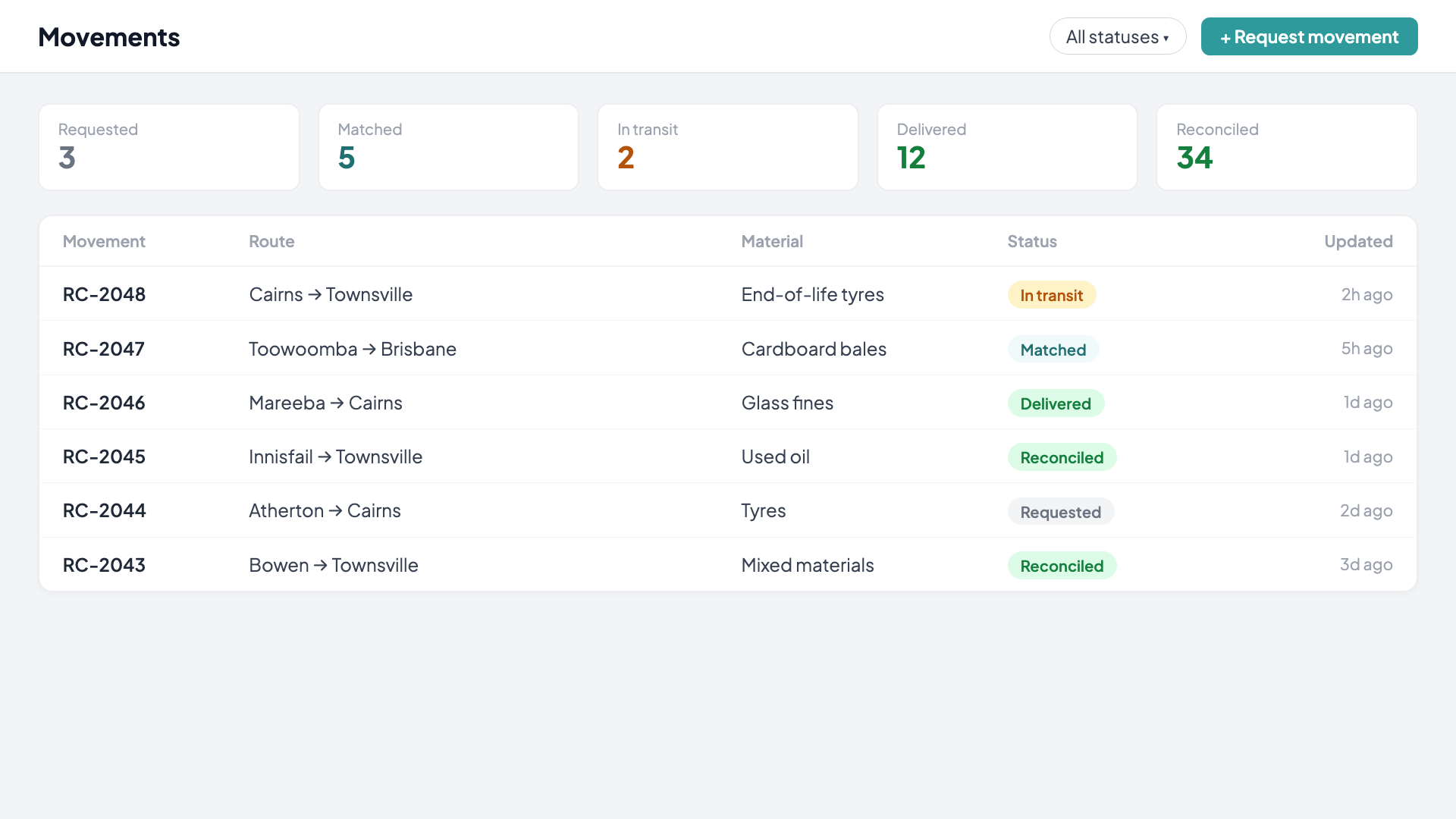
Request a movement and track it through its full lifecycle — across single or multiple sites, stops and legs — with every status visible from request to delivery.
Verified operators only
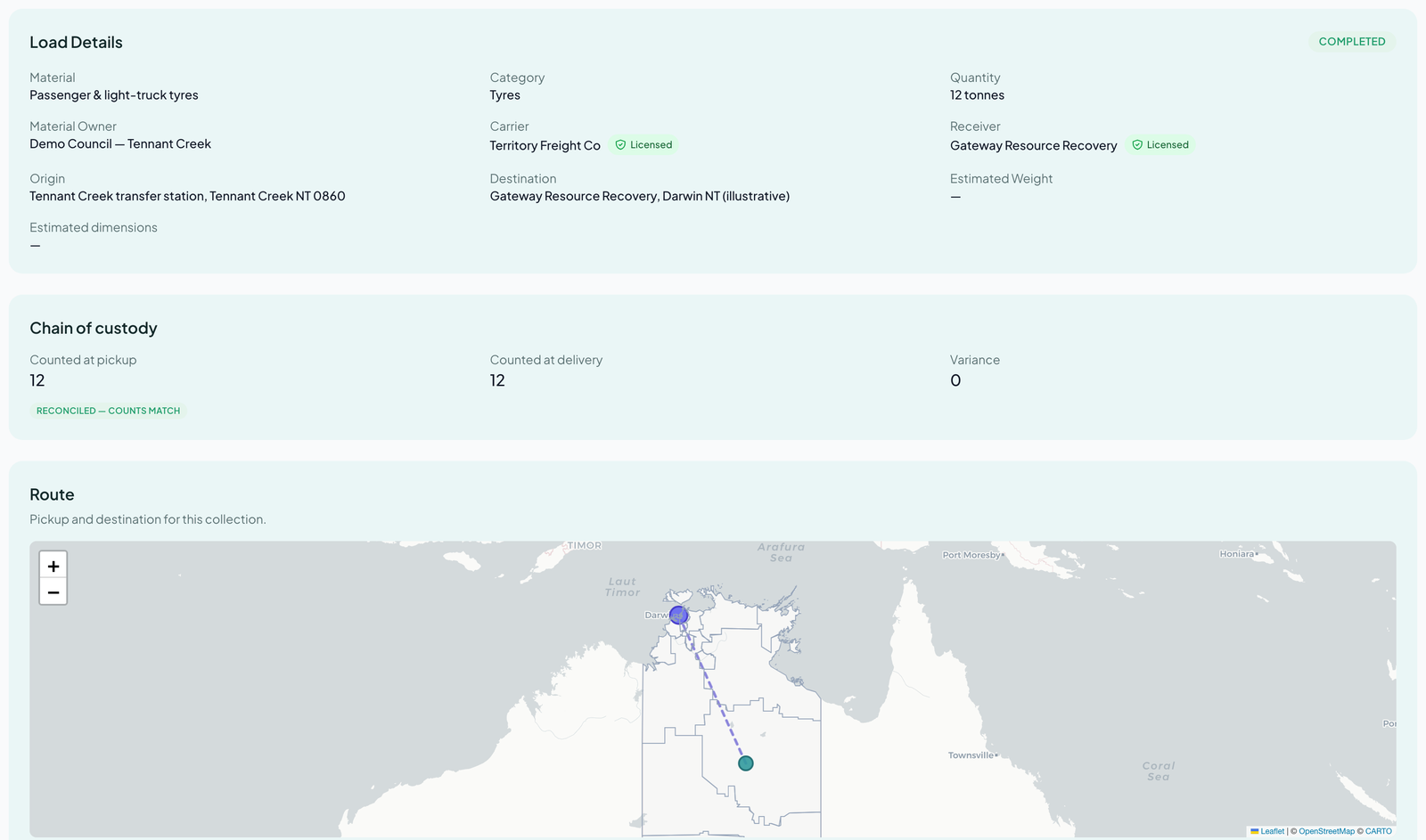
Carriers, processors and facilities are verified at onboarding, and listed materials are matched only to licensed operators — so regulated material moves with the right people.
Post spare capacity, both directions
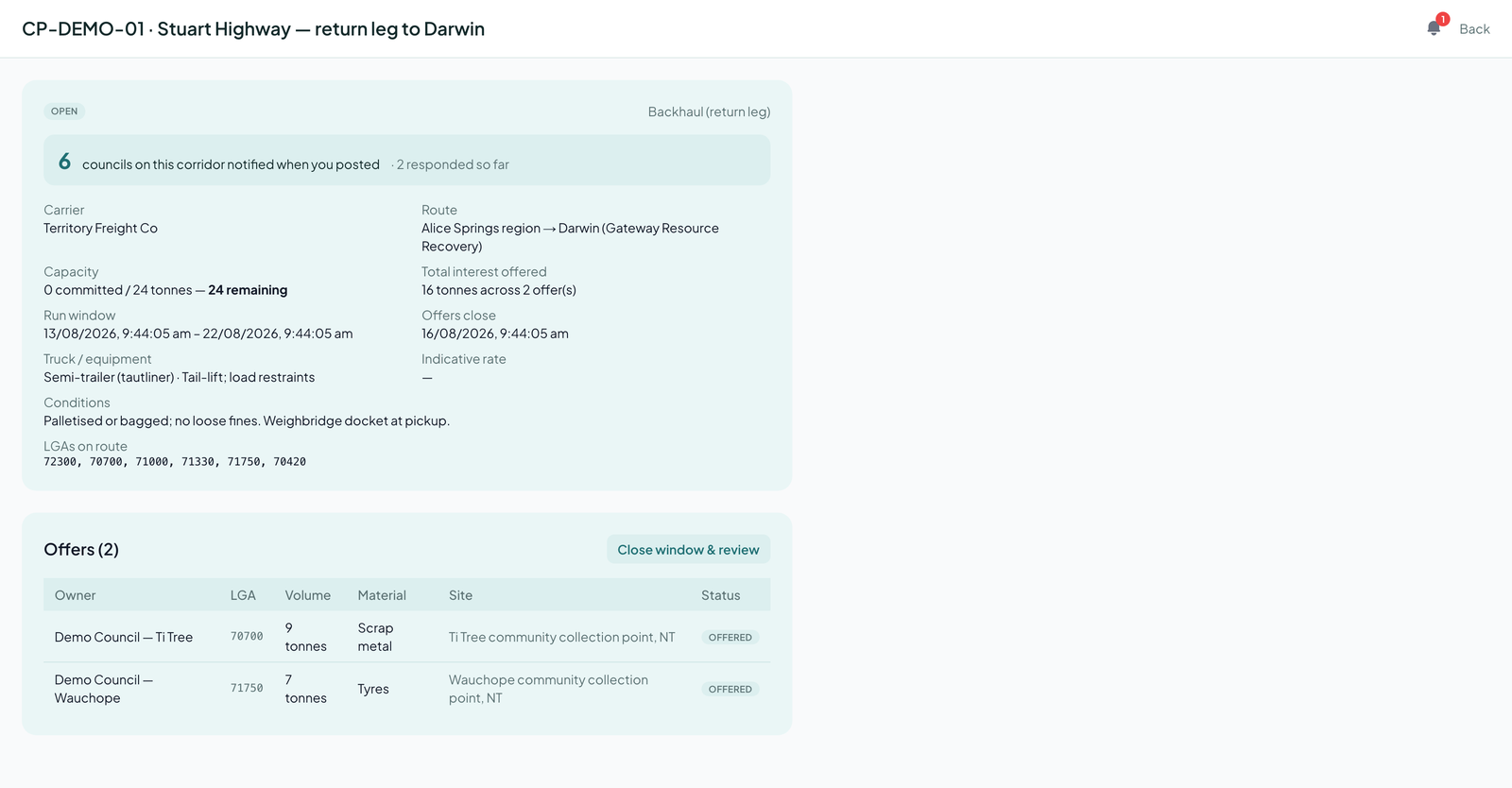
Carriers list backhaul and spare capacity against a corridor, and the councils along it are notified — surfacing demand and capacity from both directions.
Reporting that backs your case
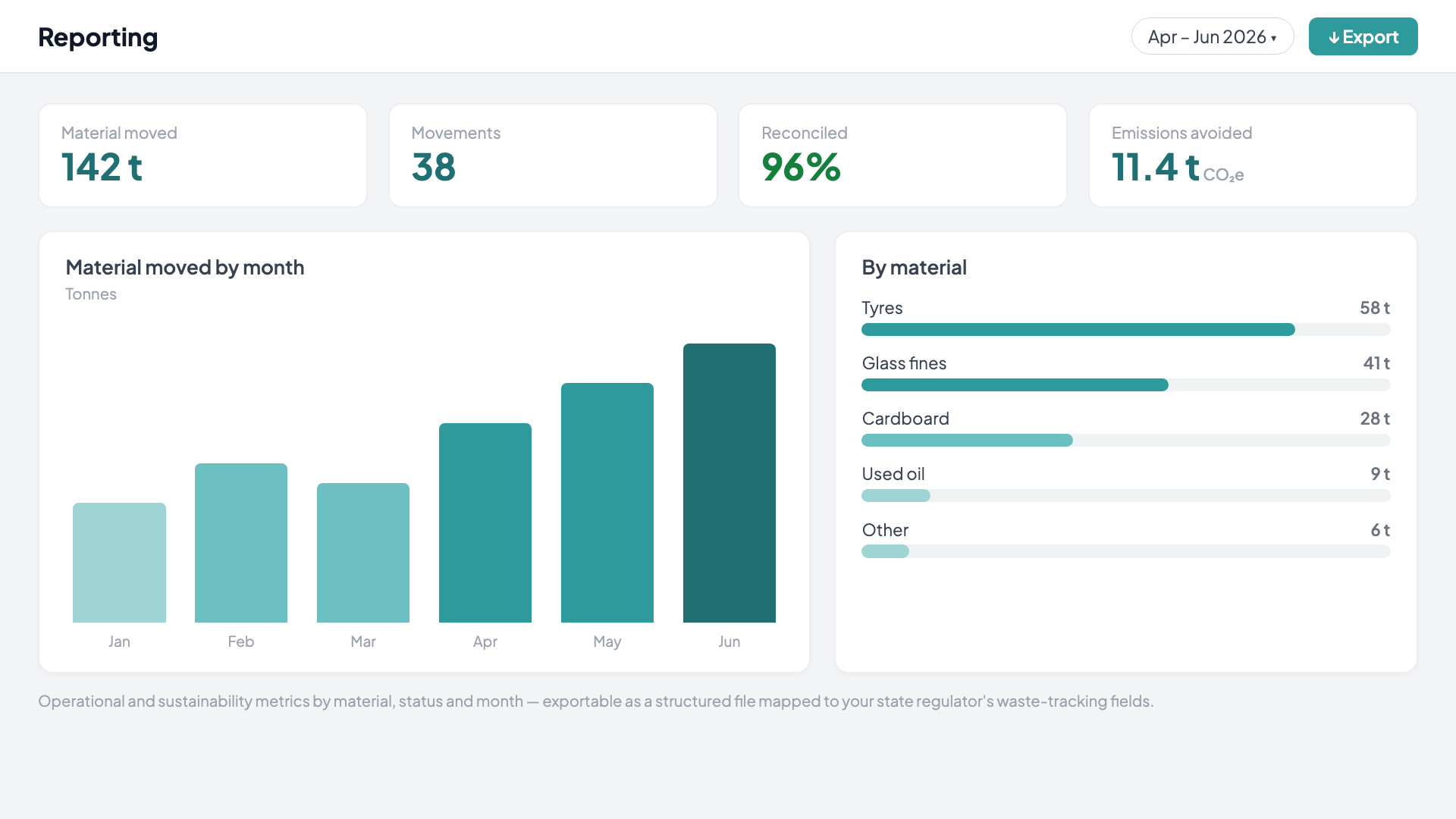
Operational and sustainability metrics by material, status and month, with a structured regulator export — generated as a by-product of moving the material.
See the network
An interactive map of the processors, sites and routes that make a region work — filterable by material, type and location.

Scope a region with built-in surveys
Understand a region's materials, volumes and barriers before a pilot — the same survey tool in front of councils now.

Illustrative demonstration data.
Coming soon: live GPS route tracking with deviation alerts — in development.
Community drop-off events
Run branded community drop-off events with full data capture and reporting — every item logged, and the council relationships and coordination built in. The material that comes in is already in the system, ready to move.
Pricing
Pricing follows what moves. Simple subscription tiers scale to how much material you move, with core reporting included as you grow and optional add-ons for deeper analysis.
Talk to usHard-to-move materials? Let's shape the solution together.
Impact is our first priority. If you've got materials that are hard to move, or an idea for a pilot, we'd rather start with the problem than the price. Tell us what you're trying to achieve and we'll work out the path — and the commercials — together.
Tell us what you're trying to move
Share the material, where it is and where it needs to go, and we'll come back to you about how it could work for your region.